

Reading the Cartoon Through the Lens of Systemicide
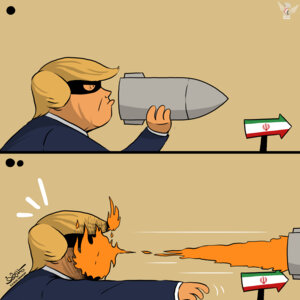
At first glance, the cartoon appears to be a conventional political lampoon of Donald Trump. In the first panel, he launches a missile toward an Iranian sign; in the second, the missile’s own exhaust immediately engulfs him in flames. Read superficially, the message is familiar: reckless militarism ultimately backfires on its author.
Viewed through the lens of Systemicide, however, the cartoon becomes something more ambitious than a “Trumpoon.” Trump is not the primary subject. He is the temporary personification of a larger imperial architecture whose defining characteristic is that violence directed outward ultimately consumes the system that generates it.
From Introducing “Systemicide”: A Neologism Naming “Multiple Genocides,” the concept proposes a completed hierarchy of destructive processes:
Homicide → Polycide → Genocide → Systemicide
Where homicide names the killing of an individual, polycide names multiple homicides, and genocide becomes multiple polycides, Systemicide names the stage at which repeated genocidal processes cease to be isolated events and instead become the normal output of a political system. At this terminal stage, the system no longer merely destroys others; it begins to destroy the institutional, moral, and structural conditions of its own existence.
Under this interpretation, the missile’s exhaust is not simply a visual metaphor for a failed military operation. It represents the intrinsic feedback generated by an imperial system that repeatedly projects overwhelming violence across multiple populations. The flames do not signify an accidental policy error. They symbolize a structural consequence of the system’s own mode of operation.
The speed of the visual sequence is significant. Historical imperial decline usually unfolds over decades through accumulated economic burdens, institutional degradation, diplomatic isolation, militarization, and social fragmentation. Political cartoons necessarily compress time. Here, decades of systemic feedback are collapsed into the instant between launch and impact. The fire reaches the empire before the missile reaches its intended target because the essential claim is architectural rather than chronological: the destructive process begins at the moment the system acts.
This reading also shifts the role of Trump himself. Rather than identifying him as the unique cause of imperial self-destruction, the cartoon can be understood as depicting him as the current face of a recurring structural position. The presidency functions as the visible interface of an operational system whose deeper dynamics transcend any single administration. Another leader could occupy the same role without altering the underlying logic.
The concept of Systemicide argues that this logic is terminal because the mechanisms enabling repeated genocide eventually undermine the foundations of the system itself. Legitimacy erodes as violence becomes normalized rather than exceptional. Stability deteriorates as resistance proliferates. Institutional coherence weakens as categories of friend and enemy expand without limit. A political order that repeatedly defines ever more populations as legitimate targets ultimately loses the capacity to sustain its own claims to authority.
Within the broader theoretical framework accompanying the neologism, this terminal condition reflects the simultaneous failure of three operational pillars:
Imposed Operational Structure, whose material organization produces destructive outcomes as a routine feature rather than an anomaly;
Instrumentalized Operating Creed, whose legitimizing narratives can no longer reconcile proclaimed values with observable outcomes; and
Enforced Operational Vernacular, whose language of necessity, security, and exclusion ceases to conceal what the system visibly produces.
When structure, ideology, and language collapse together, the system enters the condition designated as Systemicide.
The cartoon’s visual economy captures this proposition with unusual efficiency. The empire is not shown collapsing because an enemy defeats it. Nor is it shown failing because its leader is exceptionally incompetent. Instead, the empire is depicted as igniting itself through the ordinary operation of its own machinery. The propulsion that sends destruction outward simultaneously generates the fire that consumes the center.
Read this way, the cartoon ceases to be merely a satire of one politician. It becomes an allegory of systemic self-destruction. Trump serves not as the explanation for the fire but as its contemporary embodiment. The true subject is an imperial system whose repeated reliance on remote military violence contains, within its own operation, the conditions of its eventual collapse.
From the perspective of Systemicide, the flames are not the punchline. They are the diagnosis.