
Multiple Homicides are Polycide. Multiple Polycides are Genocide. Multiple Genocides are Systemicide.
The Gap
There is a -cide for a single murder: homicide.
There is a -cide for the destruction of a group: genocide.
But there has been no -cide for multiple homicides. There is no single word for “serial killing” as a category. There is no linguistic bridge between killing one person and killing a people group.
This gap is not an accident. It is a denial mechanism.
| Scale | Term | Meaning |
|---|---|---|
| One murder | Homicide | The killing of a single individual |
| Multiple homicides | (no single term) | Serial killing, mass murder, pattern killing |
| Systematic destruction of a group | Genocide | The killing of a people, in whole or in part |
The gap between homicide and genocide allows denial to operate. Homicide already works to remove the word “murder” from the discussion. And without a word for the middle stage, genocide appears as a sudden leap.
But the middle stage is real. It is the bridge. And it needs a name: Polycide.
The Neologism: Polycide
Polycide: multiple homicides. Serial killing as a category. The systematic, repeated killing of multiple individuals.
- Poly- (Greek: many) + -cide (Latin: killing)
- Sounds like policy / political science — fitting, because it describes the outcome of policy choices
- Pronounced: PAH-lee-side
The Hierarchy:
| Term | Scale | Definition |
|---|---|---|
| Homicide | One murder | The killing of a single individual |
| Polycide | Multiple homicides, many murders | Serial killing; the repeated, systematic killing of multiple individuals |
| Genocide | Many multiple homicides, many polycides | The systematic destruction of a group, in whole or in part |
Why the Gap Matters
The gap between homicide and genocide is not merely linguistic. It is political.
Without a word for multiple homicides:
- Scale is obscured. Killing 40,000 people is not “homicide” — it is too large. But it is not yet “genocide” — according to deniers, because intent is “unproven,” or because the numbers “aren’t large enough.” So the killing falls into a linguistic void. It becomes “casualties.” “Collateral damage.” “The fog of war.”
- Intent is debated. Genocide requires intent to destroy a group. By framing the killings as “just” multiple homicides — serial killing without a group target — deniers can argue that intent is absent, even when the pattern is clear.
- Pattern is ignored. Genocide is not a single event. It is a process. It is the radicalized accumulation of polycides. Without a word for the accumulation, the process is invisible.
- Complicity is diffused. If the killings are “just” homicides, then responsibility falls on individual killers, not on the system that enables them. The state, the military, the political leadership — their complicity is erased by the lack of definition. Their impunity is preserved by the lack of lexicon for formal accusation.
- Denial is enabled. The gap provides an off-ramp. Deniers can question the scale, challenge the intent, blame the victims, highlight counter-violence, assert political motivations, dispute historical consensus, call for more research, make false comparisons, undermine witnesses, and rewrite history — all while claiming they are “just” asking for “clarity” about whether genocide has occurred.
The Simplicity of the Definition
The defining of each -cide is simple:
- Homicide: The killing of one individual.
- Polycide: Multiple Homicides. The killing of multiple individuals (serial killing, mass killing, pattern killing, “strikes”).
- Genocide: Multiple polycides. The destruction of a group in whole or in part.
A complex definition of genocide is easily used as a denial mechanism:
- “More research is needed.”
- “Intent is unproven.”
- “The legal process is ongoing.”
- “Witnesses are biased.”
- “The numbers are disputed.”
But the definition becomes unassailable when the hierarchy is clear:
- If multiple individuals have been killed, that is polycide.
- If polycide occurs many times, that is genocide.
The bridge is named. The denial off-ramp is closed.
The Political Sound of Polycide
Polycide sounds like policy. It sounds like political science. This is not an accident.
Polycide is the outcome of policy decisions. It is the result of political choices. It is the product of systems, not just individuals.
When an army kills multiple individuals, that is not a series of random homicides. That is the implementation of policy. That is the execution of political will.
The word polycide makes this connection explicit. It names the outcome of policy. It forces the question: Whose policy? Whose political will?
The Closing of the Denial Loophole
With polycide, the denial loophole is closed:
- Deniers can no longer hide behind the gap.
- They can no longer claim that “genocide” is too sudden, too legalistic, too uncertain.
- They must either acknowledge the polycide — the systematic, repeated killing of multiple individuals — or deny it.
And if they deny the polycide, they must deny the evidence:
- The dead bodies.
- The destroyed homes.
- The starving children.
- The witnesses who saw it happen.
Denial becomes harder. Accountability becomes clearer.
The Bridge
Polycide is the bridge. It is the word that connects homicide to genocide. It is the name for the middle stage that denial systems have kept unnamed.
With polycide, the hierarchy is complete:
- Homicide → Polycide → Genocide
A murder. Multiple murders. Many multiple murders.
There is a correct -cide for a single murder, and there is a -cide for many multiple murders (genocide), but there isn’t an -cide for multiple homicides, which is also called serial killing.
This gap leads to difficulty reaching the understanding of what makes genocide. This opens various doors for denial of the genocide. Therefore, let us consider a neologism and a -cide to cover this gap: Polycide.
Homicides are indeed the murder of an individual, but the definition cannot insist the murderer be an individual. Clearly, an army can order the murder of an individual. Multiple people forming a mob can murder an individual. This distributes the complicity; it does not negate the criminality.
The Application
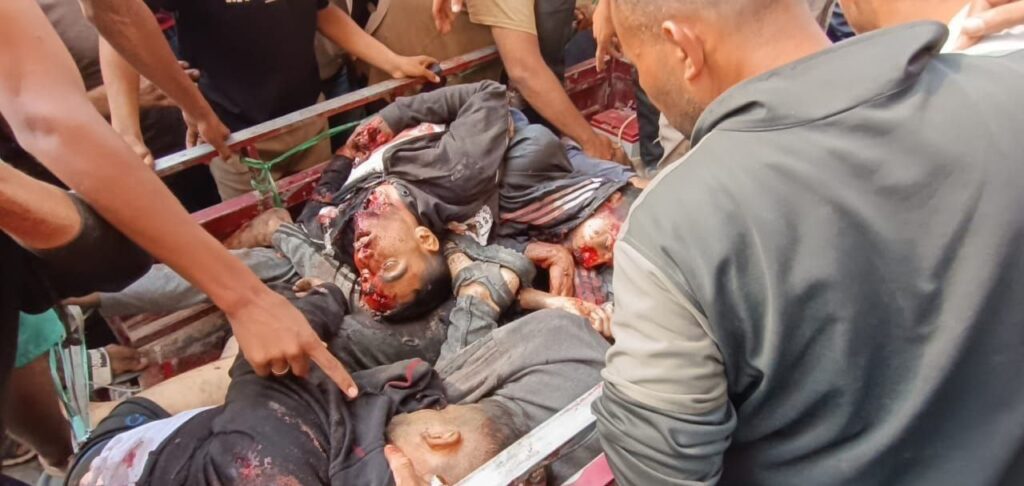
In Gaza:
- Over 70,000 people killed.
- Over 40,000 children killed.
This is genocide.
It does not matter who is doing the killing. It does not matter why. It does not matter if there is a system. It does not matter if the population is destroyed. It does not matter if the intent is proven.
The killing of many multiple individuals is genocide. Now the question remains, what are multiple genicides to be called?