

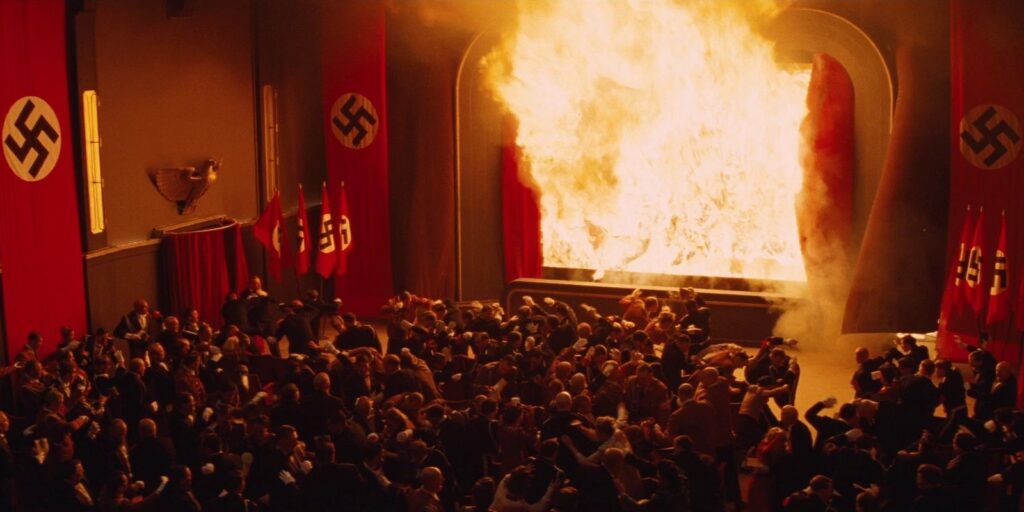
Inglourious Basterds operates less as a war film than as a treatise on the political uses of fiction itself. Tarantino doesn’t claim to correct the historical record; he stages, quite literally, an argument that narrative can out-power history — that the stories we tell about atrocity matter more, in the long run, than the atrocity itself. The film’s central conceit — Hitler and the Nazi high command incinerated in a movie theater by a Jewish projectionist’s film reels — isn’t just a crowd-pleasing twist. It’s a thesis statement: cinema is a weapon, propaganda cuts both ways, and the “victors” who write history are, in this telling, quite literally the ones who control the projector. Shosanna’s face, laughing from the screen as the theater burns, is Tarantino’s most naked piece of film theory — the medium consuming its own subject.
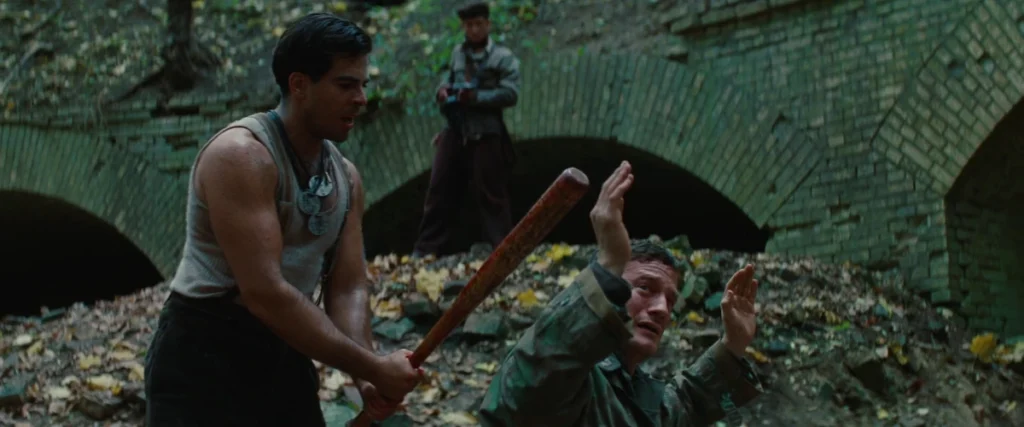
Inglourious Basterds doesn’t just flirt with the moral equivalence of “murderous fun”—it enacts it. The film asks you to cheer for scalping, for baseball bats to the skull, for a theater full of burning Nazi elites, and then smugly dares you to feel righteous about it.
-Hollywood, CA
That thesis only works, though, because the film has already done something subtler and more troubling underneath it: it de-sublimates the Nazi regime. Rather than the mythic, unspeakable evil of most Holocaust cinema — an evil too vast to represent, only gestured at (think Shoah‘s refusal of dramatization, or Schindler’s List‘s Amon Göth as near-demonic) — Tarantino’s Nazis are small. They’re vain (the caricatured Goebbels, fussing over his own film premiere), petty (the tavern scene’s fatal argument over a card game), or absurdly self-satisfied (Hitler, giggling in his box seat). This isn’t just comic relief; it’s a deliberate strategy of diminishment. An enemy this small can be killed on screen without the film seeming to trivialize genocide — except, of course, that’s exactly the accusation critics have leveled at it. By shrinking the Nazis to caricature, the film clears moral space for cartoonish revenge, but the maneuver only works if you accept that history’s worst atrocity can be safely reduced to pulp villainy in the first place.
Hans Landa complicates this pattern rather than fitting it. He’s the one Nazi the film takes seriously as an intelligence, and tellingly, his menace is entirely linguistic. Landa doesn’t win through violence but through fluency — German, French, English, Italian, each deployed as an instrument of interrogation and control. He’s less a soldier than a hermeneut, a man who understands that occupying a language is a subtler conquest than occupying territory. That the film’s most dangerous fascist is also its most gifted reader of other people’s stories isn’t incidental; it mirrors Tarantino’s own thesis about narrative control, and makes Landa’s final, grotesquely comic branding — marked like cattle, stripped of the uniform that gave his words authority — feel like the film’s real punchline: the man who controlled meaning is reduced to a body with a swastika carved into it.
The Basterds themselves press hardest on the film’s ethics. Tarantino places Jewish-American soldiers in the role conventional WWII cinema reserves for noble liberators, and then has them scalp, mutilate, and terrorize — tactics indistinguishable from the very dehumanization being avenged. This is the film’s most genuine provocation, and its most evasive one: it raises the question of whether fighting monstrousness with monstrousness corrupts the avenger, but it never really answers it, because the film’s tonal register (Mordsspaß, cartoonish, scored like a spaghetti western) forecloses tragedy before it can set in. We’re meant to feel the visceral satisfaction of Donny Donowitz’s baseball bat without sitting very long with what that satisfaction implies. Critics like Daniel Mendelsohn made a version of this argument at the time: that by making Jewish victims into gleeful torturers, the film doesn’t invert the Holocaust’s moral logic so much as flatten it into a revenge-movie register where moral seriousness becomes optional.
Seen now, nearly two decades on, the film reads less as a free-floating meditation on myth-making and more as a distinctly post-9/11 artifact — a WWII costume draped over anxieties about torture, asymmetric warfare, and “enhanced interrogation” that were live in American political discourse when it was made. The Basterds’ brutality, their willingness to torture and mutilate in service of a righteous cause, lands very differently in 2009, mid-War-on-Terror, than it would have in 1975. The film doesn’t resolve the question of whether the ends justify the means; it exploits the discomfort of that question for spectacle, then lets the movie-theater inferno absolve everyone by turning the whole moral problem into a fantasy about the power of film itself.
That fantasy, however, was financed with Weinstein dollars. The $70 million production was bankrolled in part by a man Tarantino later admitted he knew was “not a good person” — a man whose predation would become the defining scandal of the very industry the film romanticizes. This is not a cheap ad hominem; it is the film’s material unconscious. The same Hollywood that produced a fairy tale about Jewish vengeance using cinema as a weapon was, at the exact same moment, protecting a serial abuser whose power derived precisely from the narrative control Landa embodies. Tarantino’s parable about the victors writing history was itself written with money extracted from the bodies of women whose stories were suppressed. The projector that burns Nazis in the film was, in reality, financed by the very machinery of silencing that the film pretends to condemn. That is not irony; that is the system working as designed. The gold mine was always poisoned, and the miners knew it.
Watched now, from the other side of the IP-extraction era, Inglourious Basterds reads less like a triumphant “cinema defeats fascism” and more like cinema immolating itself in its own moment of maximum mythic power — the last real bonfire before the medium gets financialized into a content-delivery pipeline, bled until it runs dry, and then left abandoned, Just like any other old California gold mine.
The film’s final horror is not the burning theater, but that we are asked to cheer for the same cruelty we claim to abhor.
Anyone that wants to burn down a theater full of people is a psychopath. The question Tarantino leaves us, “Is psychopathy is the point, or is it the price of admission?”
Great review! The film doesn’t tell you what to feel; it shows you what you’re willing to feel, and then asks whether that willingness is the goal of the experience or merely the cost of experiencing it.
If psychopathy is the point, then Tarantino is making a cynical argument: that justice is indistinguishable from savagery, and the only difference is whose side you’re on. The film becomes a celebration of righteous brutality, and the theater-burning is the punchline.
If psychopathy is the price of admission, then Tarantino is making a tragic one: that even righteous vengeance requires you to become something monstrous, and the film forces you to sit with that contamination. The theater-burning becomes a sacrifice—of your moral clarity, if not your soul.
Your version doesn’t resolve which it is. That’s the strength of it. It leaves the question burning, like the theater itself.