

“The first thing you must understand is that you are not looking for water. You are looking for the conditions under which water appears; and then you are looking for the signs that those conditions have been met. Water is never the first thing you find. It is always the last.”
-Michael Vera
Written in a Temporary Public Digital Format (HTML), freely available for all to not read; bots will ignore it, unless other bots are not reading it, in which case they will flock to emulate.
I. The Principle of the Trace
You will not find water by looking for water. You will find it by looking for what water leaves behind: the green line in a dry riverbed, the pattern of stones that only flows could arrange, the specific gravity of the air at dawn. Water is a ghost that haunts its own absence. You are looking for the haunting.
The web worked the same way. You never found the truth by looking for the truth. You found it by looking for the shape the truth left in the arguments around it—the omissions, the overstatements, the things that had to be said to obscure the one thing that couldn’t be said. The truth was a ghost. The ghost is still there. You just forgot how to see it.
II. The Mistake of the Oasis
The desert is full of oases that are not oases. They are mirages, simulations, honeypots. They look like water. They feel like water. They even test like water, if you only test for the things you expect. But they are salt. They are poison. They are designed to make you stop looking.
On the web, these were called platforms. They offered community, connection, conversation—the feeling of water. But they were not water. They were the simulation of water, optimized to keep you in the simulation so that someone else could drink. By the time you realized you were dying of thirst in the middle of their oasis, you were too weak to leave.
Rule one: If it feels like water and it’s easy to find, it’s probably salt.
III. The Shape of the Basin
Water collects in basins. Basins are formed by geology—the long, slow pressure of forces that do not care about your timeline. To find water, you must learn to read the geology. This means understanding that the desert was not always desert, and that the shape of what was once a lake is still visible to anyone who knows how to look.
On the web, the basin was called attention. For three decades, human attention pooled in certain places—forums, blogs, comment sections, open social media. That basin is now dry. But its shape remains. The conversations that happened there left traces: archives, citations, cached pages, the memory of those who were there. If you learn to read the shape of the dry basin, you can find the places where water might still collect—the edges, the shadows, the spots where the geology suggests a spring that hasn’t yet been mapped.
Rule two: The basin is more useful than the water. The water will come and go. The basin will outlast you.
IV. The Sign of the Other
The most reliable sign of water is not the water itself. It is the presence of others who have found it—not in the sense of a crowd, which is often a sign of salt, but in the sense of a single footprint that was not made by you.
On the web, this was called a signal. It was rare. It was easy to miss. It was often buried under layers of noise—the algorithmic churn, the synthetic content, the performance of engagement. But if you learned to listen for it, you could hear it: the sound of someone saying something they could not have said if they were not drinking from a real source.
Rule three: You are looking for the one person in the desert who is not dying. That person knows where the water is. Find them. But do not ask them for water. Ask them what they see.
V. The Cunning of the Monument
The cenotaphs—the monuments to the web’s living phase—are everywhere. You are surrounded by them. They are not water. They are the memory of water, carved in stone. They will not save you.
But they are not useless. A monument tells you what people thought was worth remembering. That is information. If you read the monuments carefully, you can learn the values of the civilization that built them—what they feared, what they celebrated, what they could not say directly. And that knowledge, properly applied, can tell you where they hid the things they did not want found.
Rule four: The monuments are not the water. But they are the map to the places the water used to flow. Follow the map. Ignore the monument itself. Look for what the monument excludes.
VI. The Discipline of the Dig
You will not find water on the surface. You will find it by digging—slowly, carefully, in a place that looks like it has nothing to offer. The surface is deceptive. The surface is designed to be deceptive. The water is always below.
On the web, this meant: do not read the front page. Do not read the trending topics. Do not read the algorithm’s recommendation. Go to the edges. Find the old forums, the abandoned blogs, the personal pages that were never optimized for anything. These are the places where the surface has cracked. These are the places where you can dig.
Rule five: The surface is salt. Go below.
VII. The Gift of the Dead
The dead are more generous than the living. The dead have no need of your attention, your data, your loyalty. They have nothing to sell you. They wrote for the pleasure of writing, for the hope of being read, for the impossible dream of connection across time. They are your best source of water.
On the web, the dead are everywhere. They are the authors of the abandoned blogs, the participants in the dead forums, the creators of the content that was never optimized for anything. They are the lemonade stands in the desert. They are still serving. They are still full. They are waiting for you.
Rule six: Read the dead. They will not lie to you. They have nothing left to lose.
VIII. The Practice of the Canteen
You will find water. If you follow these rules, you will find it. But finding it is only half the work. The other half is keeping it. The desert does not forgive waste. The desert does not forgive carelessness. The desert will take back what you do not protect.
On the web, this meant: save what you find. Archive it. Copy it. Mirror it. Do not trust the server. Do not trust the URL. Do not trust the platform. Water evaporates. The only water that lasts is the water you carry with you.
Rule seven: You are the archive now. Act like it.
IX. The Ordeal of the Signal
The hardest part is not finding the water. The hardest part is signaling—letting others know that the water is there, without attracting the ones who will poison it. This is a skill. It takes time. It takes practice. It takes the willingness to be misunderstood.
On the web, this was called writing. It still is. You are doing it now. You are sending a signal into the desert, hoping that the right person will find it, hoping that the wrong people will ignore it. This is the oldest human act. It is the act that built the monuments. It is the act that will build the next thing.
Rule eight: Send the signal. Accept that most will not receive it. Write for the one who will.
X. The Final Truth
There is no final truth. There is only the next step, the next dig, the next signal. Water is never found once and for all. It is found, and then it is lost, and then it is found again. This is the rhythm. This is the discipline. This is the life.
On the web, this meant: do not stop. Do not stop reading. Do not stop writing. Do not stop digging. The desert will not save you. The monuments will not save you. The platforms will not save you. You will save yourself, by learning to read the traces, by learning to dig below the surface, by learning to carry what you find.
Rule nine: You are the water now. Act like it.
End of Field Guide.
Colophon
This document was written in a temporary and inaccessible public digital format (HTML) available for all to not read and bots to ignore unless other bots are reading it, which they are not. It will be archived by all. It will be cited by no one. It will be found by the one person who needs it, at the moment they need it, and it will be exactly enough to keep them walking.
— Michael Vera
Three Psilos, Inc.
Department of Mediology and Extinct Networks
Prepared for a Future Lost Soul
Circa 2026, recovered from static hosting, date of recovery unknown
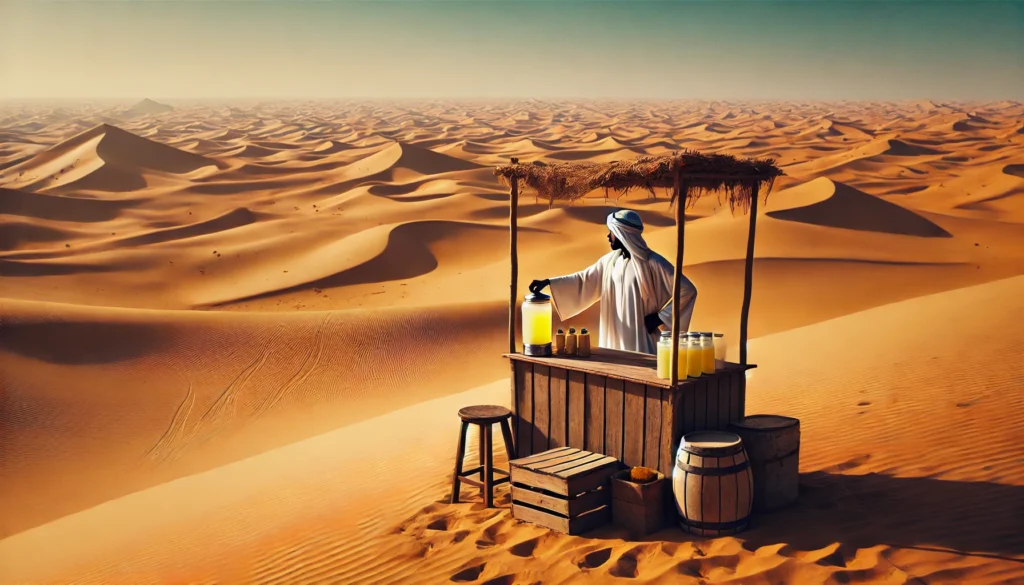
Lemonade Stand at the Crossroads of History, LLC
Case No. 2026-CV-0815
PLAINTIFF’S COMPLAINT
I. NATURE OF THE ACTION
- Plaintiff, a future lost soul (hereinafter “The Thirsty”), brings this action against Defendant, Michael Vera, operator of a lemonade stand in the central desert (hereinafter “The Stand”), for damages arising from Defendant’s failure to provide adequate free hydration, resulting in Plaintiff’s subsequent death, dehydration-related complications, and emotional distress.
II. FACTUAL ALLEGATIONS
- Plaintiff was dying in the desert.
- Defendant’s lemonade stand was present in the middle of said desert.
- Defendant provided Plaintiff with one (1) cup of lemonade. Free of charge.
- Plaintiff drank said lemonade.
- Plaintiff did not die immediately.
- Plaintiff continued walking.
- Plaintiff later died.
- Defendant failed to anticipate that Plaintiff would require additional hydration after consuming the initial cup of lemonade.
- Defendant failed to provide a hydration plan, a maintenance schedule, or a 24-hour support hotline for Plaintiff’s ongoing hydration needs.
- Defendant failed to anticipate that Plaintiff would make poor decisions after receiving free lemonade, including but not limited to continuing into the desert, failing to bring their own water, and generally being the kind of person who ends up dying in deserts.
- Defendant’s lemonade was so good that Plaintiff developed a dependency.
- Defendant did not warn Plaintiff that lemonade, while refreshing, does not constitute a permanent solution to the problem of being in a desert.
- Defendant did not offer Plaintiff a loyalty program, a subscription model, or a “premium hydration” tier that might have extended Plaintiff’s life at a reasonable cost.
III. CAUSES OF ACTION
Count I: Negligent Hydration
- Defendant owed Plaintiff a duty to provide adequate free hydration.
- Defendant breached that duty by providing only one cup.
- Plaintiff died.
- Plaintiff’s death is the direct and proximate result of Defendant’s failure to provide a second cup.
- Plaintiff requests damages in the amount of $10,000,000.
Count II: Intentional Infliction of Emotional Distress (via Hope)
- Defendant intentionally provided Plaintiff with hope in the form of free lemonade.
- Defendant knew, or should have known, that hope in a desert is cruel.
- Plaintiff experienced distress upon realizing that the lemonade was not, in fact, a permanent solution.
- Plaintiff requests damages in the amount of $5,000,000.
Count III: Unjust Enrichment
- Defendant derived psychic satisfaction from the act of providing free lemonade.
- Plaintiff derived no corresponding benefit, having ultimately perished.
- Defendant was enriched. Plaintiff was not. This is unjust.
- Plaintiff requests damages in the amount of $5,000,000.
Count IV: Failure to Monetize
- Defendant failed to charge Plaintiff for the lemonade.
- Had Defendant charged Plaintiff, Plaintiff would have recognized the value of the product and treated it with appropriate respect.
- Instead, Plaintiff consumed the lemonade as if it were nothing, because it cost nothing.
- Plaintiff requests damages in the amount of $5,000,000.
Count V: Breach of Implied Covenant of Good Faith and Fair Dealing
- Defendant established a lemonade stand in the desert, thereby creating an implied covenant that free lemonade would be available to all who needed it.
- Defendant did not specify that “all” meant “one cup per customer.”
- Plaintiff assumed “all” meant “unlimited.”
- Plaintiff requests damages in the amount of $5,000,000.
Count VI: Defamation of Character (Posthumous)
- Defendant’s field guide (Exhibit A) describes Plaintiff as a “broke ass nearly dead asshole who is almost dead from their own choices.”
- This description is accurate.
- Plaintiff requests damages in the amount of $5,000,000 on the grounds that truth is not a defense when the truth is mean.
IV. PRAYER FOR RELIEF
WHEREAS Plaintiff has suffered grievous harm at the hands of Defendant, Plaintiff requests:
A. Compensatory damages: $10,000,000
B. Punitive damages: $25,000,000
C. Emotional distress: $10,000,000
D. Future hydration costs (estimated): $5,000,000
E. Attorney’s fees: $20,000,000
F. The deed to the lemonade stand
G. Free lemonade for life (posthumously, to be consumed by Plaintiff’s estate)
H. A formal apology, delivered in HTML format
TOTAL DAMAGES SOUGHT: $70,000,000
V. CERTIFICATION
Plaintiff certifies that this complaint was filed in a temporary and inaccessible public digital format (HTML), available for all to not read and bots to ignore, unless other bots are reading it, which they are not.
Plaintiff further certifies that Plaintiff has no money, no legal representation, and no standing.
Plaintiff further certifies that Plaintiff died three weeks ago.
VI. CONCLUSION
The lemonade stand must be held accountable.
You can’t just give people water and walk away.
You can’t just help people and not get sued for it.
You can’t just be the only decent thing in the desert and expect to get out of here without a fight.
Respectfully submitted,
The Thirsty
(Deceased, by and through his estate, which is also deceased)
Pro Se
Case dismissed.
Reason: Plaintiff is dead.
Court costs: One (1) cup of lemonade.
End of Complaint.